
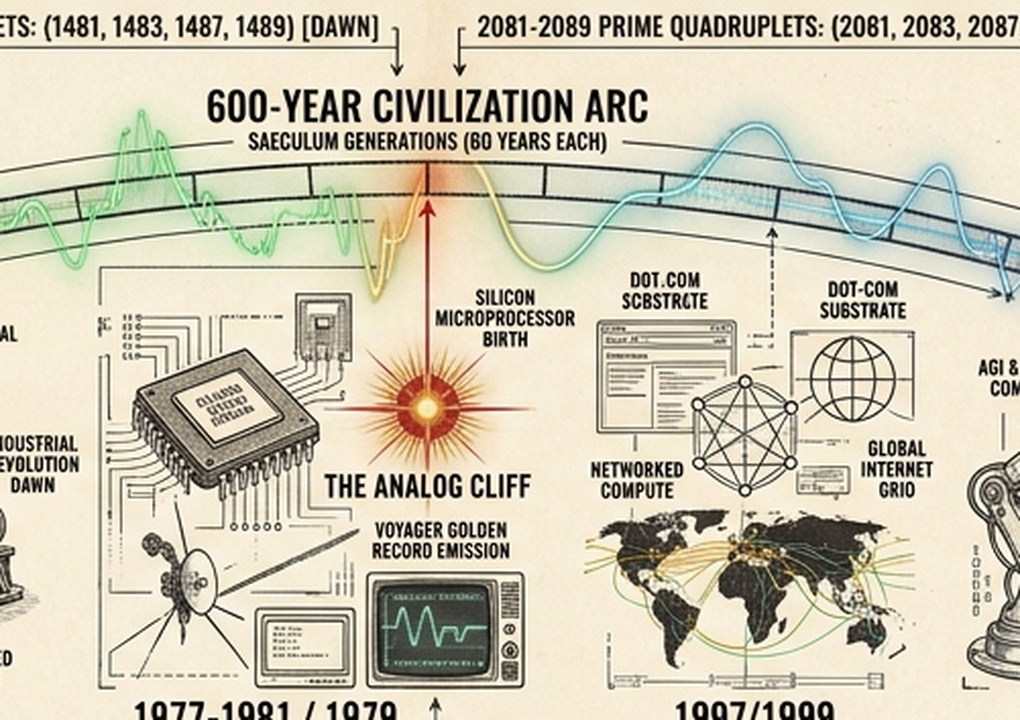
Monograph N° 095 // Sunday Archive Historiography Registered PEF Research // Tom Marchesello
An Inquiry into Number Theory Distributions and Historical Timelines
Author: Tom Marchesello Scope: Mathematical Models & Historical Chronology Timeline: AD 1 to 2100 Overview
In number theory, the distribution of prime numbers exhibits clear structural behaviors governed by sieve mechanisms and the Prime Number Theorem. When abstract numerical sequences—such as twin prime gaps—are mapped onto historical calendar dates, apparent patterns often emerge. This document reviews the mathematical properties of prime distributions alongside historical timelines, while highlighting the cognitive tendency to find correlation within periodic datasets.
Section 01
Twin Prime Gaps & Mathematical Steps
Twin primes are pairs of primes that differ by 2. As numbers grow larger, the overall density of primes decreases, yet twin primes continue to appear across uneven intervals.
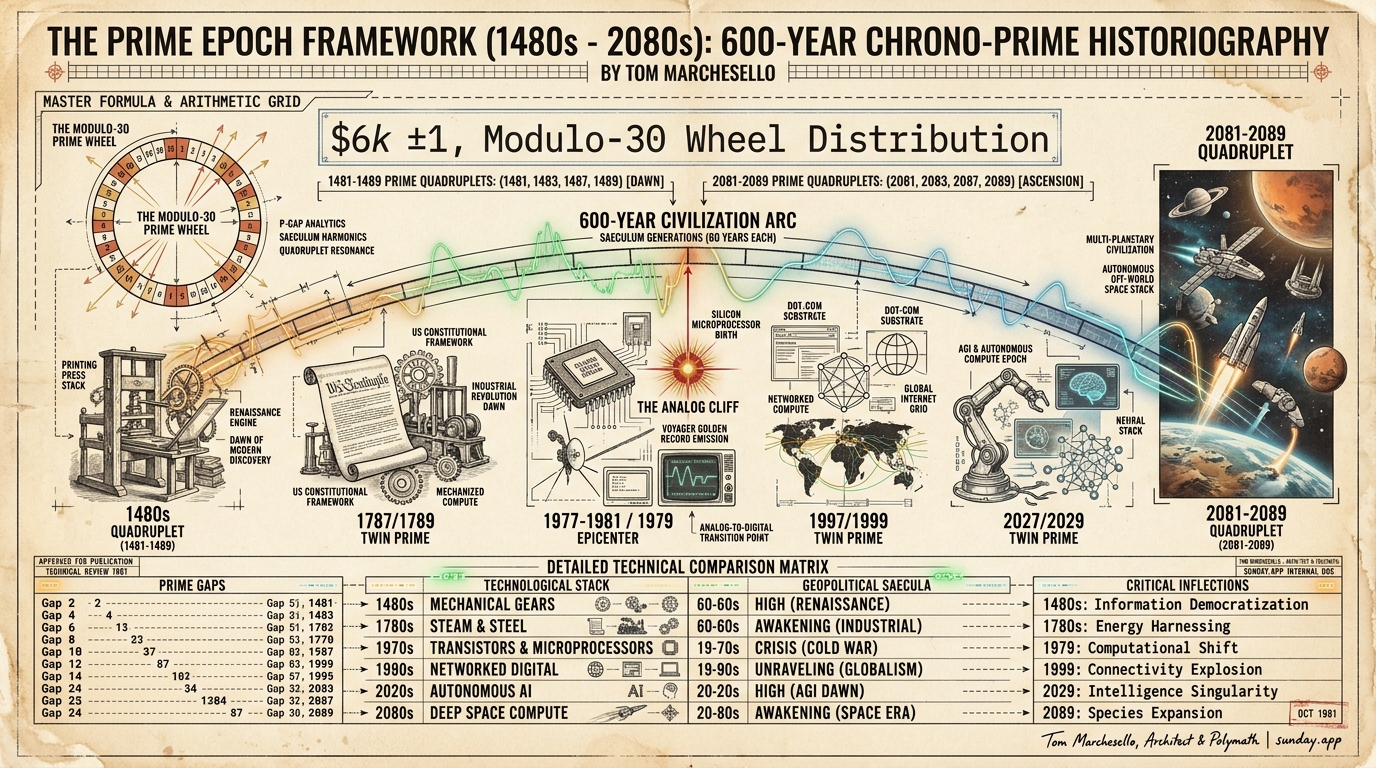
Historical Gap 1787/1789 to 1949/1951 Interval: 162 Years (27 × 6)
A prolonged span between twin prime occurrences in this numerical segment, illustrating natural sieve gaps.
Mid-Century Shift 1949/1951 to 1997/1999 Interval: 48 Years (8 × 6)
A shorter gap between prime pairs, demonstrating the irregular clustering inherent to prime distributions.
Recent Interval 1997/1999 to 2027/2029 Interval: 30 Years (5 × 6)
A concise step in the sequence. While striking when viewed linearly, such variances are well-documented phenomena in computational arithmetic.
Section 02
Sieve Mechanics & Number Theory Foundations
The Prime Number Theorem
The density of primes near a numberNapproximates 1 / ln(N). Consequently, primes thin out over larger ranges. For instance, the first millennium contains 34 twin prime pairs, whereas the second millennium contains only 25 pairs.
Multiples of Six
Every prime greater than 3 can be expressed as 6k± 1. Because all twin prime pairs greater than (3, 5) center around a multiple of 6, the differences between consecutive pairs naturally factor by 6.
Section 03
Timeline & Correlation Analysis
Because human history contains an ongoing series of geopolitical, ecological, and economic events, overlaying any mathematical sequence will regularly intersect with notable occurrences.
| Twin Prime Pair | Interval (Years) | Historical Context |
|---|---|---|
| (1787, 1789) | 66y | French Revolution, global geopolitical shifts. |
| (1829, 1831) | 42y | Second Cholera Pandemic, regional volcanic activity. |
| (1949, 1951) | 68y | Post-WWII restructuring, Korean conflict. |
| (1997, 1999) | 48y | Asian Financial Crisis, rapid growth of internet infrastructure. |
| (2027, 2029) | 30y | Projected calendar horizon; ongoing technological adaptation. |
Section 04
Epistemic Distinctions
Level 1
Mathematical Realities
Properties of numbers, modular arithmetic, and prime distribution formulas exist independent of human calendar conventions or record-keeping.
Level 2
Empirical Records
Historical events such as treaties, geological incidents, and demographic changes occur continuously across all decades, regardless of year-number properties.
Level 3
Constructed Systems
The Gregorian calendar and standard epoch definitions are human frameworks, meaning alignment with purely numerical sequences is largely arbitrary.
Level 4
Pattern Interpretation
Human perception naturally seeks narrative links between unrelated quantitative series, often reading causal cycles into statistical coincidence.
Rigorous inquiry benefits from separating proven mathematical principles from the open-ended nature of historical change.
SUNDAY Research Archive // Historiography Series