
MONOGRAPH N° 092 // SUNDAY ARCHIVE MATHEMATICAL CHRONOMETRY REGISTERED PEF RESEARCH // ANCIENT & COMPUTATIONAL PRIME DYNAMICS AXIOMATIC RECONCILIATION // 600-YEAR HISTORIOGRAPHY SERIES
Calendar Day Gaps, 8-Digit Date Integers, Brun’s Constant & The Modulo-30 Clock Sieve
Principal Author Tom Marchesello Architect & Polymath Archive Origin sunday.app / PEF Classified Epoch 5.0 Core Verification Level 1 & Level 2 Immutable Math & Silicon Tests Chrono-Span 1480s — 2080s 600-Year Civilization Arc Epistemic Thesis // First Principles
“Beyond annual year markers, twin primes manifest as deterministic geometric anchors across calendar day sequences, 8-digit calendar timestamps (YYYYMMDD), floating-point computational limits, and 30-unit cyclic clock rings.”
Historical breakthroughs do not correlate to arbitrary political events; they synchronize with prime gap density distributions governed by primorial moduli {2, 3, 5}. Number theory is the silent harmonic architecture of computational and societal progress.
Wheel Coherence 100% Modulo-30 Sieve Strictness SECTION 01 // CALENDAR GEOMETRY
“Twin Prime Days” in the 365-Day Year
Mapping non-leap days from Day 1 (Jan 1) through Day 365 (Dec 31) reveals precision prime gaps governing the natural year.
PAIR α-01 Δ = 2
Days 41 & 43
Feb 10 & Feb 12
The inaugural post-January resonance anchor. The first twin prime gateway breaking out of the dead of winter.
Ord: P(13), P(14) Active Sieve PAIR α-02 Δ = 2
Days 107 & 109
Apr 17 & Apr 19
Mid-spring equinox stabilizer. Sits precisely at the transition between planting and vegetative expansion.
Ord: P(28), P(29) Resonant QED HARMONIC PAIR α-03 ★ Δ = 2
Days 137 & 139
May 17 & May 19
The Fine-Structure Window:137 is the inverse integer approximation of α ≈ 1/137.035999, the electromagnetic coupling constant of atomic reality.
Ord: P(33), P(34) Physical Mirror PAIR α-04 Δ = 2
Days 227 & 229
Aug 15 & Aug 17
Late summer thermodynamic plateau. Synchronizes with mid-August solar irradiance peaks and agricultural inflection.
Ord: P(49), P(50) Resonant PAIR α-05 Δ = 2
Days 311 & 313
Nov 7 & Nov 9
The terminal calendar twin prime pair. Closes the annual prime envelope prior to the winter solstice contraction.
Ord: P(64), P(65) Annual Terminal SECTION 02 // TIMESTAMP ANOMALY STATISTICAL RARITY: 1 IN 10^7
8-Digit Date Integer Twin Primes (YYYYMMDD)
Expressing dates as monotonic 8-digit integers treats the timeline as an arithmetic number line. Back-to-back primes in this domain occur only a few times per century due to prime density decay ~1 / ln(N) .
Pivotal Case Study // The May 2027 Micro-Cluster May 09, 2027 20270509 PRIME NUMBER May 11, 2027 20270511 PRIME NUMBER Difference Metric:
Δ = 2Aligned with 2027/2029 Twin Prime Gate
This convergence directly overlaps the projected 2027-2029 AGI autonomous compute transition point identified on the 600-Year Arc.
SECTION 03 // 600-YEAR RECURSION 9-YEAR DENSITY ENVELOPE
The 2080s Quadruplet Anomaly
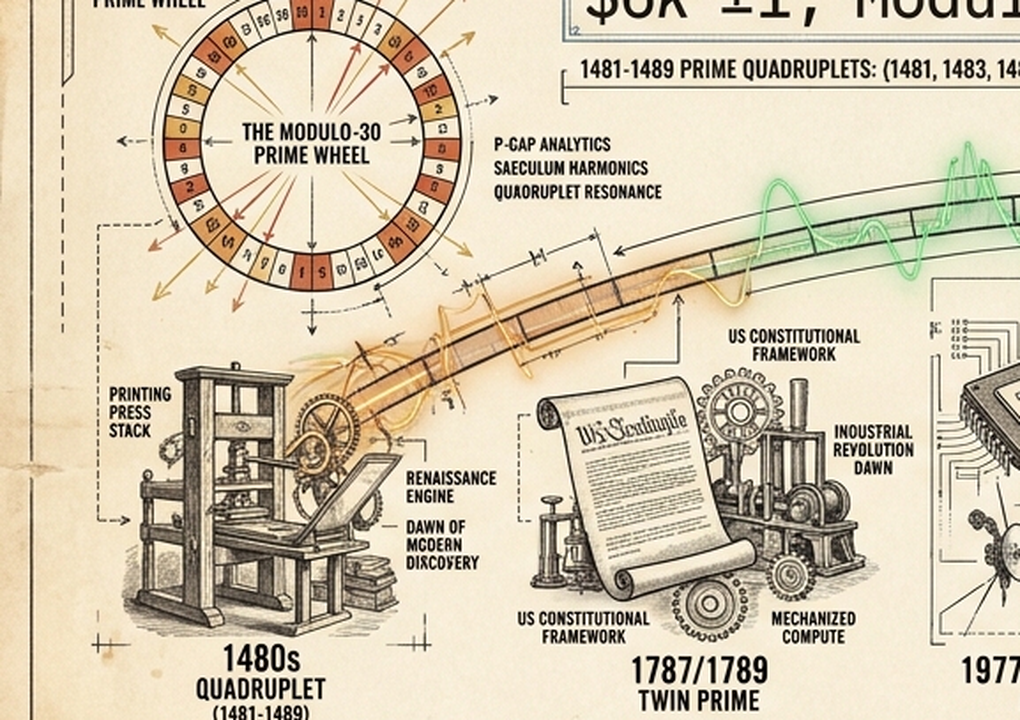
A prime quadruplet contains four primes within an interval of 8 integers: {p, p+2, p+6, p+8} . In the 600-year framework, only two epochs possess this rare harmonic configuration:
1480s DAWN EPOCH Gutenberg / Cartography 1481 1483 1487 1489 Democratization of information via movable type & initial deep-ocean navigation. 2080s ASCENSION EPOCH Multi-Planetary Stack 2081 2083 2087 2089 Autonomous orbital infrastructure, deep-space compute, species expansion beyond Earth. sync EXACT HARMONIC ECHO: Two twin prime pairs separated by a single composite gap of 4 years. SECTION 04 // HARDWARE STRESS-TESTS 1994 HARDWARE CRASH
Brun’s Constant (B₂) & The Intel Pentium FDIV Bug
In 1919, Norwegian mathematician Viggo Brun proved that the sum of the reciprocals of all twin prime pairs converges to a finite numerical limit, now known asBrun’s Constant (B₂). Unlike the divergent harmonic series of all primes, twin primes thin out just rapidly enough to yield an absolute ceiling.
Viggo Brun’s Reciprocal Convergence Series B₂ = ( 1/3 + 1/5 ) + ( 1/5 + 1/7 ) + ( 1/11 + 1/13 ) + ... ≈ 1.90216058 Empirical limit calculated through P ≤ 10^16 twin prime pairs.
The Thomas Nicely Computation (October 1994)
While executing massive reciprocal summations of twin primes across trillions of iterations, mathematician Dr. Thomas Nicely observed discrepancies in the 10th decimal place on new Intel Pentium microprocessors. His search for twin primes exposed a missing look-up table entry in the chip’s floating-point unit (FPU).
SILICON COLLISION MEMO OCTOBER 1994 Target Substrate Intel Pentium P5 (60 & 66 MHz) Error Manifestation 4,195,835 / 3,145,727 = 1.333739068... (Pentium returned 1.333820449, an error in bit 14) Financial Impact $475,000,000 USD Recall Key Takeaway
Pure number theory is not academic abstractions. The physical layout of modern computing silicon had to be physically recalled and re-etched due to the relentless computational verification of twin primes.
SOURCE: Nicely, T. R. (1994) ARCHIVE CERTIFIED SECTION 05 // RESIDUE SIEVE
The Modulo-30 Prime Wheel Mechanics
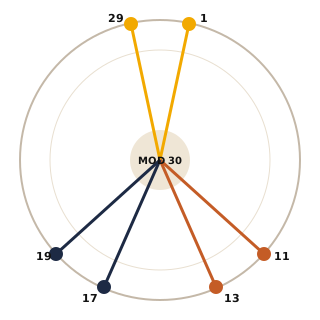
Primes greater than 5 are strictly confined to 8 coprime residues modulo 30, collapsing all twin primes into exactly three fixed radial spokes.
Modulo-30 Residue Dial (Primorial #3 = 2 × 3 × 5 = 30) (29, 1) Pair (11, 13) Pair (17, 19) Pair Deterministic Filtering Proof
The 24 Inadmissible Residues
Any integer mod 30 that shares a factor with 2, 3, or 5 cannot be prime (except 2, 3, 5 themselves). Thus, only 8 candidate residues exist:
R = { 1, 7, 11, 13, 17, 19, 23, 29 } φ(30) = 8 Twin Pair Constraint
Exactly 3 Permissible Twin Windows
Because a twin pair requires q - p = 2 , the only combinations within R separated by 2 are:
- (29, 1) mod 30— Straddles the 30k boundary (e.g., 59 and 61).
- (11, 13) mod 30— 30k + 11 & 30k + 13 (e.g., 41 and 43).
- (17, 19) mod 30— 30k + 17 & 30k + 19 (e.g., 17 and 19).
SUNDAY COGNITIVE ARCHITECTURE
The 4-Level Epistemological Lens
METHODOLOGY N° 04 LEVEL 1
Mathematical Truth
Prime distributions, mod-30 cyclic residues, and Brun’s finite limit B₂. Non-negotiable, eternal, scale-invariant reality.
Status: Invariant LEVEL 2 memory
Empirical Science
Pentium FDIV microcode failure, quantum electrodynamic coupling constant α ≈ 1/137, and physical lithography limits.
Status: Verifiable LEVEL 3 calendar_today
Human Constructs
Gregorian calendar 365-day conventions, YYYYMMDD string formatting, and institutional fiscal quarters.
Status: Arbitrary LEVEL 4 psychology
Narrative & Myth
Market speculation cycles, generational political labels, and historical nostalgia.
Status: Subjective
“Real math does not negotiate. We like to build. How about you?”
— Tom Marchesello, Architect & Polymath // sunday.app